
Yours, and offline
Your data never leaves your machine. No account, no telemetry, and a licence key checked on the computer itself.
About Neurones 3D
Neurones 3D began with a surveyor's question, asked alone in the office the night before a deadline: couldn't this be automated? This is the answer, built as one engine you can hold in a single file.
The question
Before the research and the code, Florent Poux was a land surveyor: out on site with the instrument, then back at the desk translating the real world into digital plans, one point at a time.
One evening stayed with him. A file of 2,587 surveyed points sat on the screen, a topographic map was due the next morning, and the work ahead was the same work as the day before. That is when the question arrived, and it has not left since.
Every feature in Neurones 3D is a version of it. Not can we look at the scan, but can the scan turn itself into the deliverable: the plan, the section, the terrain model, the volume, the report.
Going through these monotonous data points, I had my spark moment: "Couldn't this be automated?" That question, fuelled by a late-night cup of coffee, changed everything.
Who makes it
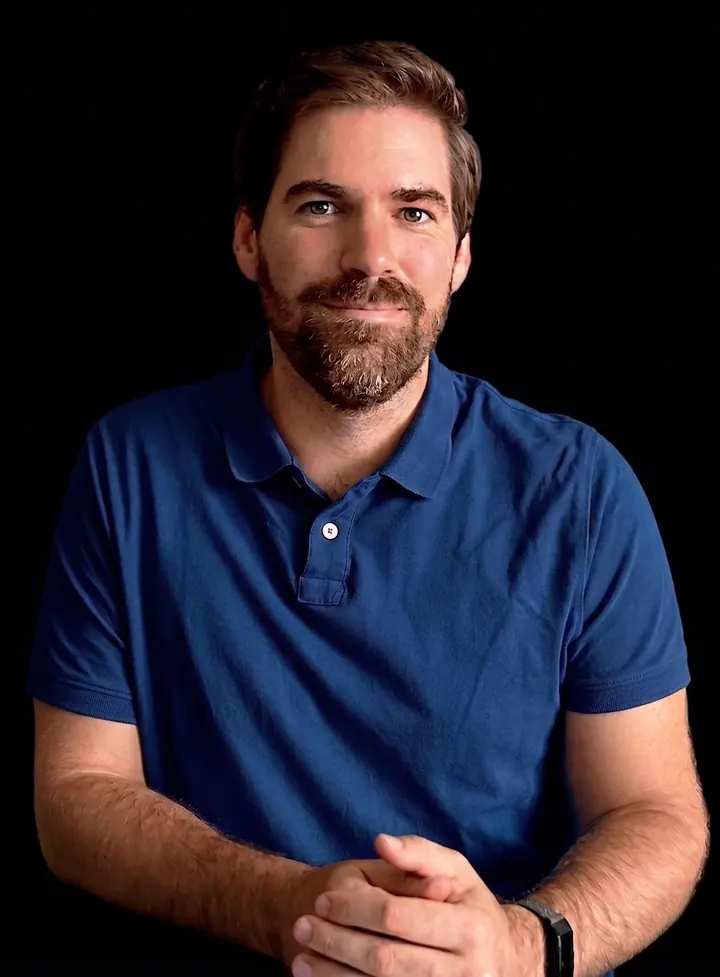
Florent Poux has spent fifteen years on a single problem: making reality capture answer for itself. First on site with a survey tripod, then in the lab, where his Ph.D. at the University of Liège gave the problem a name, then as a professor, and now at the academy he directs.
"I did not set out to build software," he says. "I set out to stop wasting good data." Neurones 3D is where that research stops being a paper and becomes a program you can run.
From the lab to everyone
Research on point clouds usually stays where it was made: in papers, in lab code that needs its author to run it, on machines most offices do not have. Neurones 3D takes the Smart Point Cloud, the idea at the centre of that Ph.D., and puts it in one offline download that runs on an ordinary laptop.
A smart point cloud is one where every point knows not only where it is, but what it is, what it relates to, and how the next process can use it.
Billions of points streamed from disk out of core: LAS, LAZ, E57, PLY and Gaussian splats, at interactive frame rates.
Segmentation, primitives and four trained classifiers: indoor, aerial LiDAR, streetscape and powerlines.
Scene graphs of rooms and objects, their adjacency, and the spaces a building is made of.
Floor plans, sections, terrain rasters, change maps, volumes and reports, written by the engine itself.
The road
The learning curve, in his words, was steeper than the Pyrenees climbs he rides for fun. The path went from the field to the lab, into industry, and back out to the people who do the work.
The field, the instrument, and plans drawn one point at a time. Where the question was asked.
From a blue-collar job to a Ph.D. at the University of Liège on the Smart Point Cloud, then years of research and a professorship.
Helping companies put 3D data to work, from optimising factory layouts to designing medical implants.
Director of the academy and author of 3D Data Science with Python (O'Reilly). Teaching professionals to ask the question for themselves.
Open everything: LAS, LAZ and COPC, E57 with its 360° panoramas, and Gaussian splats, rendered out of core. Free for Windows.
Deviation in seconds, clouds aligned automatically, USD models written, and a point cloud you can send someone.
Dimensioned floor plans with sections and elevations, scene graphs of rooms, M3C2 change detection and USD import.

Why an engine
Neurones 3D started in Python, the way most of the research did. It worked, but it was heavy. So it was rebuilt from nothing in Rust, from the file readers to the renderer, under a single rule: stay frugal.
"In an age where every tool reaches for a data centre, I wanted the opposite."
One file. No installer, no account, no cloud, no telemetry. Billions of points on ordinary hardware, because the index streams from disk instead of filling memory. And one package that carries you from capture to understanding to deliverable, without exporting to five other programs along the way.
What it stands for
Your data never leaves your machine. No account, no telemetry, and a licence key checked on the computer itself.
Every speed and accuracy figure on this site was measured on named data, and the reports say how.
Pure Rust, one executable, and an out-of-core index, so billions of points open on a ten-year-old laptop.
Plans, sections, terrain rasters, change maps, meshes and reports: the thing you were going to be paid for.
Every guide ends with what the process does not do, and every figure keeps its level of detection beside it.
The science behind each process is written down in the book and taught at the academy, not locked in a black box.
By the numbers
Measured on the engine's own benchmark harness and test suite, September 2026.
Made by the engine


The science behind it
Published by O'Reilly. From loading a first point cloud to segmentation, registration, meshing and 3D deep learning: the ideas that Neurones 3D puts into a single program.
Read about the book → 3D Geodata AcademyThe academy Florent Poux directs teaches point cloud processing, 3D machine learning and geodata workflows to surveyors, engineers and researchers.
Visit learngeodata.eu →Free for Windows, forever. Open your own scan, or try one of the demo scenes built into the app.
This site keeps only what it needs to work: a voting token on the board, a draft of a feedback message, and this choice. There is no analytics and no advertising. What is stored, and why.